Showing posts with label design. Show all posts

Friday, October 10, 2025

Ten Commandments for Godbound

I talk about Godbound a lot (free version available here, and the deluxe version available here; free version is complete and has everything you need, the deluxe version just has extra content, it's basically an included splatbook).  It is probably my favorite RPG.  Therefore I decided it deserves a blog post, so here are ten commandments for running Godbound.  The first two, and the tenth, are house rules, and labeled as such; the rest are advice.

Obviously, I'm calling them ten commandments for the joke, but in reality do whatever you want, I'm not your boss.

1 - (House rule) Normal attacks can be defensively miracled by any effect that would make sense to defend against the attack form.  The core game states that normal attacks can only be blocked if you can miracle up a specific defensive Gift.  This limits player options, creates pressure for players to take specific Words that can defend against normal attacks, and also makes powerful bosses have an incentive to use their least interesting attack; normal attacks from divine opposition usually deal so much straight damage that, unless blocked with a Gift, a character can be killed in a single round with focus fire.  Allowing any thematically appropriate miracle to block them fixes these incentives, and it's still a very bad situation for a character to be in if they need to repeatedly block normal attacks without being specialized in doing so, because they're committing Effort for the day and the attacker isn't using any Effort at all.  (This is very bad for the defender.)

2- (House rule) Any defensive miracle, defensive dispel, or offensive dispel must be described in terms of its in-world effect.  The in-world effect must be able to achieve the desired goal.  The action has whatever result and duration the in-world effect would have, with one restriction; defensive or non-damaging actions can't be used to harm worthy foes.  (On the other hand, if you're defensively dispelling a fireball with the Word of Fire, sure, go ahead and just deflect it onto some lesser foes.)  This helps maintain investment in the world and tension and investment in combat.  It also helps keep combat fresh and exciting; you never just attack or defend.  You create fog to hide from an enemy, who freezes the fog into spears of ice to cast at you, so you transmute the ice into snow and are unharmed.  Everything follows what has come before and creates an unbroken chain of back and forth.

3 - You cannot apply optimizer logic to this game and expect it to work.  If at any point you start thinking about a tier list or grading options by color, you have fucked up and you must stop what you are doing immediately.  The Words are each the best at the thing that they do.  Whether or not you want that thing is up to you, but that's what they do.  The Gifts on the page are only examples; you can take a Gift for anything that you could miracle up.  If you think a particular Word doesn't have the right Gifts, or its Gifts are too good, take some other ones then, that's your problem.  The only "balance problem" in any Godbound book or supplement is Purity of Brilliant Law, and that was just a mistake which was fixed in Lexicon of the Throne; nothing's perfect and mistakes do happen.

4 - You should fight non-divine opposition.  Not just have it there to describe it being removed, but actual combat encounters.  An ordinary ogre vs a single 1st-level godbound is about comparable to an Easy D&D-type encounter; the godbound is almost certainly going to win, but unless they are extremely combat-focused, they will have to take damage or expend resources to do so.  A Small Mob of ogres is a perfectly viable combat encounter for a group of 1st-level Godbound, or a Large Mob of goblins; a Vast Mob of ordinary goblins is likely to defeat the group!.  If every combat encounter where you bother to get out the dice is against divine opposition, it makes the world feel much more divine and makes the characters feel less special and less mythic.  You need to have an actual fantasy world, not just a bunch of gods and divine beasts in a fighting tournament.  If you don't invest in creating a world and making it feel like a world, the players won't invest on their end, and the whole game falls apart from there.  Divine level opposition is for special occassions, bosses, and telegraphed things.

5 - The book mentions this, but it is worth reiterating.  For Godbound past the first few levels, the question most often is not 'am I capable of doing this'.  Because you are.  You can force it to happen if you want to.  The real question is how far are you willing to go to make it happen.  For basically anything in a normal human town or city, you could make people do whatever you want; you might have to kill some people or magically enslave people or burn down some buildings or level 75% of the city, but all of these are within your power.  Do you really care enough about your goal to do those things, though?  Where are your lines, what are the things you won't do; and what goals will tempt you to break the lines that no one but you can enforce on yourself?  Obviously the players should think about this, but the GM should think about it too.

6 - Another thing that the book mentions, but worth reiterating; your characters must have ambition.  You must have not only goals, but the drive and willingness to achieve those goals.  A group of Godbound don't have the kind of mundane challenges that normal people would; you're never going to struggle to put food on the table or pay rent or mortgages.  It's going to get covered.  If all you want to do is have a comfortable middle-class life, there's not a whole lot that can stop you.  This is not usually a great campaign.  You need to have goals, preferably incredible goals commensurate with divinity.  You can't just want to be the strongest in a small village; you're already that.  You need to want to be the strongest in the universe.  You can't just want to build a tower and library in the wilderness; again, you can do that at 1st level.  You need to want to build the Tower of Babel, and prevent it from falling down, and store every book in every language ever written.  You won't be able to do these things immediately.  You might not even be able to start immediately.  But you'll be able to think about it and work toward it immediately, and that's the kind of call to adventure that a Godbound party needs.  Just as a Godbound character is much more powerful than a starting D&D character, their goals need to be more powerful to motivate them.  Godbound characters work and act on a scale layer higher than normal D&D characters; a 'five dungeon adventure' is the Godbound equivalent of a 'five room dungeon'.  That kind of scale increase needs to apply to their goals as well.

7 - There is no such thing as flavor text.  This ties into commandment 2, but is more generalized.  Any description has its logical effect on the world; nothing should be ignored or allowed to violate diegetic precedent or in-world laws.  For example, a blast of cold can freeze loose water, and a blast of fire can ignite easily flammable materials.  However, this should be balanced by remembering that the characters are divinities, and can control things!  A Godbound of Fire can throw a blast of fire that only burns what they want it to burn, because they're the god of fire.  If a Godbound of Winter is throwing torches around for some reason, they might accidentally ignite a fire.  These forces should be balanced by considering the player's intent and their abilities.  As the Godbound of Sword can deal nonlethal blows with a chainsword but a Godbound of Passion cannot, the same logic should be applied to all other effects.  All effects, all abilities, and all powers have the logical effect on the world based on what you know about the world and the description of the power's effect in the world; except when the Godbound intends otherwise and has the power and skill necessary to prevent it.  By maintaining the normal laws of cause and effect whenever possible, it helps players feel more mythic and more associated with their character's abilities and divinity when they get to ignore them.

8 - The book recommends that the setting be a world on the brink of disaster or shortly after disaster.  This is a fine starting point, especially if your party is the kind that needs a bit of a kick to action, but it isn't actually required.  It's perfectly viable to play Godbound in a normal, stable fantasy setting.  What's important is that its equilibrium is weak enough that Godbound can upset it; which is pretty likely.  Even the Forgottem Realms would have trouble maintaining a stable equilibrium against the concerted force of a party of high-level Godbound, the actual gods would need to start stepping in (and if they did it one at a time, max level Godbound might still win).  It's perfectly fine to just use a setting that's famliar to you and all the players, as long as you go in with the understanding that canon stops when the first session starts.  Everything after that is going to be affected or flavored, or directly caused by, the actions of the players.  Using an existing setting can also help with getting players invested into the setting, which in turn helps support their goals and ambitions, and those are both important core parts of getting good gameplay out of your Godbound.

9 - Do you have modules and settings for any OSR or NSR game that you've read and enjoyed, but never gotten to run?  Or maybe just haven't gotten to run as often as you like?  Use them as minor challenges for Godbound characters!  Ever picked up a megadungeon, the kind of thing that consumes a years-long campaign, and you really know you're never going to get through it even if you did manage to run it for a few months sometime?  Let some Godbound at it for 1d12 sessions and it'll be at least mostly gone.  Godbound can blow through standard OSR setups at vastly increased speeds.  This is a great way to implement Commandment 4 (about non-divine opposition); you don't have to change the modules at all.  They're a minor challenge to Godbound.  Anything that normal OSR characters would do in one session is about equivalent to a long combat encounter for Godbound; you'll blow through most one-shot dungeons in an hour or less of game time.  The accelerated pace of gameplay lets you feel your power, but as you rush though because you don't feel the threat, you'll tend to find traps the hard way (unless you have Gifts for it) and draw multiple encounters at once.  Then you'll still win and it will be great.  There's no drawbacks.  (Side note:  Some people have historically complained about things like a Godbound character dying to an OSR-style save or die trap as you might find in an unmodified module.  Remember that a Godbound can always Commit Effort to succeed in a save, and they can do this after rolling.  So if you die to a poison trap, it's because you a) failed a saving throw and b) didn't have any divine power left to save yourself with, because all your Effort was Committed and you kept going on anyway.  Godbound are not immortal and if you've spent your entire store of energy, you're still kind of a badass by OSR standards but you are by definition not able to draw on divine power.)

10 - (House rule) XP is not necessary for Godbound.  You already need to spend Dominion to level up, which is the result of diegetic actions.  You can just remove XP and use Dominion alone to level.  (If you want to really go all the way, you can also require that unlocking new Words, instead of costing you Gift points, is done in-world by locating the Word's celestial engine, associated artifact, or other physical item or special location.)  This is an example of the systemic flexibility of Godbound; there are very few games that normally use XP where you can say that you can just remove it and it'll be fine.  Of course it will change things, and it's up to you if you want that change, but if you do want something to change about the system, it is very likely that you can just change it and it will be no big deal.  (For example, I say you don't need XP because Dominion spend is required to level; that's because I think the Dominion spend is more important and valuable to the things that interest me about Godbound.  But you could just as easily remove the Dominion requirement and keep XP, and it'd still be fine)

Secret Eleventh Commandment - An it harm none, do as thou wilt.  Godbound is a game built on an OSR chassis and cross-compatible with almost any OSR game.  It is very, very flexible and resilient.  You can basically do whatever you feel like to the system, as long as the group agrees, and it will work out.  If someone wants their divine powers to work a little bit differently from the default expectations, make some stuff up and run with it, it's very likely to work just fine.  This can be used to simulate specific worlds or abilities, or just to make things different.  If you want to use something from another OSR game, just use it, don't worry about converting to make it consistent; it'll work fine.  All commandments aside, one of the reasons why I like Godbound so much is this flexibility, because it provides you with a framework that can support basically whatever you want as long as you can fit it into its theming.

Wednesday, July 16, 2025

Holes of the Systemic Variety

From the widest gully to the deepest trench, holes define who we are and where we are going.  And although Rover here may not know it, he is participating in a ritual as old as time itself; he is giving birth to a hole.

I mean, uh, holes.  That's what this post is about.  Specifically, systemic holes.  In order to talk about a systemic hole, first we need to define them.

A systemic hole is a hole in a system.

Ok, that was easy.

The question then is, what is a hole in a system, and how do you identify them?  No system will cover everything, and it shouldn't be expected to.  A system actively choosing not to cover or include something is not a hole; it's a wall, a boundary.  Just like people, it's good for systems to set boundaries and enforce them as needed.  

A hole is something you trip over or fall into.  It's nothing where you expected something.  It gets in your way and blocks travel, or you get stuck inside it and can't get out.  So a systemic hole is a place where a system failed to include something that it implied; a thing that the system seems like it wants you to do, but then gives you no way to actually do it.

An easy example from recent times would be ship combat rules in the 5E Spelljammer adaptation.  The setting has ships, it has combat, you'd think that you might want to do both of these at the same time; but the rules given for it are anemic at best, basically just a handwave about how to use your ships to do personal scale combat.  This is a systemic hole, because the system leads you to expect something and then you fall in a hole.

This implies two basic things to ask.  First, if you're designing a system, how do you avoid filling it with holes?  Second, if you have encountered a hole in a system that you're using, what do do you do about it?

When designing a system, to avoid holes, you need to maintain your focus.  Set your boundaries and stay within them.  A lot of holes in systems are the result of the designer not staying within the boundaries that they set.  If you're making a fantasy adventure game, for example, and you add a throwaway line about "Players may be able to rule domains and engage in mass combat", you just dug yourself a hole.  Players are going to want to do that and they will go looking for the rules, and then they fall in the hole because there's no rules there.  If you can't resist mentioning things like this, make it clear that they are out of bounds for this game right now; for example, "Future supplements may add options for ruling a domain and mass combat" or "If your players want to take over the world, you're on your own, good luck GM".  Again, just like people; set your boundaries and communicate them.  There are no holes outside the boundaries of your system (or, if there are, they're not your problem).  The only holes you care about are the ones inside your system area.  Your system is about the things that it is about.  If someone wants to use it for something else, that's their problem.  Don't dig holes inside your system boundaries, making the game worse for people trying to play it as intended, just to support a hypothetical person who wants to take it outside the bounds.

The second question is what to do about it if you find a hole in a system you're using.  There are two basic options for this; go around it or fill it in.  Going around it is much easier, but harder to describe, so we'll talk about filling it in first.  Filling it in just means homebrewing something.  A complete explanation of how to homebrew things is outside the scope of this post (so it's not a hole that I'm not explaining it), but Ten Rules of RPG Design is a good place to start.  You fill in the hole by providing the missing rule or rules.

To go around, you do the opposite; you remove the rules that imply the hole.  Using Spelljammer as an example again because I'm too lazy to think of a second example, the grid-scale ship movement rules are the strongest implication that there should be ship combat rules.  So you remove them.  Ships can't move on a grid and there's no particular way to track that.  Now no one expects ship-to-ship combat; if you want to get in a fight in space, you do it using your personal-scale grid rules.  The lack of ship-to-ship combat is no longer a hole, no longer implied that it should be part of the game, because a new boundary was drawn, and it's outside the boundary.

Holes are all about expectations.  A hole is something you trip over or fall into.  If you know that there's nothing there, that the space you're about to travel to is out of bounds, then there's no problem; you're forewarned and, hopefully, forearmed.  If your system correctly sets and communicates your boundaries, it will make expectations clear, and there will be no holes for anyone to trip over.

Thursday, March 27, 2025

The Nodecrawl Post

 This is the nodecrawl post.  A nodecrawl is the way that I tend to think about information that isn't organized in a more specific way.  As this post will later define, there are many ways to think about information at different levels of abstraction and one or another can be the best for you.  The nodecrawl is the most universal, and therefore most abstracted, way to think about pacing and travel through a sequence of imagined spaces or units of time.

Thesis: All crawls are the same thing, a way of presenting and pacing travel through an imagined space or time.  They can be generalized as nodecrawls, where you move from node to node through linkages.  A linkage is how you travel from one node to another node.  A node is not a point of interest, though it might contain points of interest.  Rather, a node is whatever location or nexus you can travel within without needing to engage your systemic travel mechanics.  Use of a linkage moves you from one node to another but engages the systemic travel mechanics.

Here's some examples of existing things expressed as nodecrawls and the mechanics they use:

Classic dungeon crawls:  A room is a node.  Moving from one room to another takes up 1 turn of game time.  Events such as random encounters may trigger when moving or as time passes, torches burn down, etc.

Hexcrawls:  A hex is a node.  Moving from one hex to another requires your game's overland travel mechanics.  Exploring within a hex uses different mechanics, details varying by exact game.

Citycrawls:  A district or neighborhood is a node.  Moving from one district to another utilizes your travel mechanics, while travel within the district (from one shop to another) does not.

Wavecrawls:  An island is a node.  Moving from one island to another utilizes your game's travel mechanics.

Skycrawl:  A Land is a node.  Moving from one Land to another uses the travel mechanics.

If you're famliar with all of these, you might notice an additional thing; points of interest can occur during a linkage as well as at a node.  If you're trying to draw this on an actual hexmap, this can be annoying, because you need to place it exactly within a hex and figure out which hex it's in, since you're in the process of moving from one to another.  With a nodecrawl map, it's easy; you just put it on the linkage that goes from A to B, and when the party travels from A to B along that linkage, you know that they have the option for that PoI along the way.

A node and its linkage can be defined at whatever level of 'zoom' or abstraction that you want to define it at.  It's also worth nothing that this helps free up easy ways to diagram things that are not limited by in-game terrain; a shortcut or teleportation portal, for example, is annoying to include on a traditional hexmap.  But on a nodecrawl map, it's just another linkage.  A has a linkage to B, and also a linkage to F.  Of course, you don't have to explicitly diagram out every possible linkage either, if you're doing something like a hexmap or a dungeon map.  On a standard hexmap, every face of a hex is a linkage to the other hex that it touches, unless you need to define otherwise (perhaps a range of high mountains can be accessed only through one face of its hex, and none of the other faces are linkages, which you could diagram on the map by putting a / though every inaccessible face).

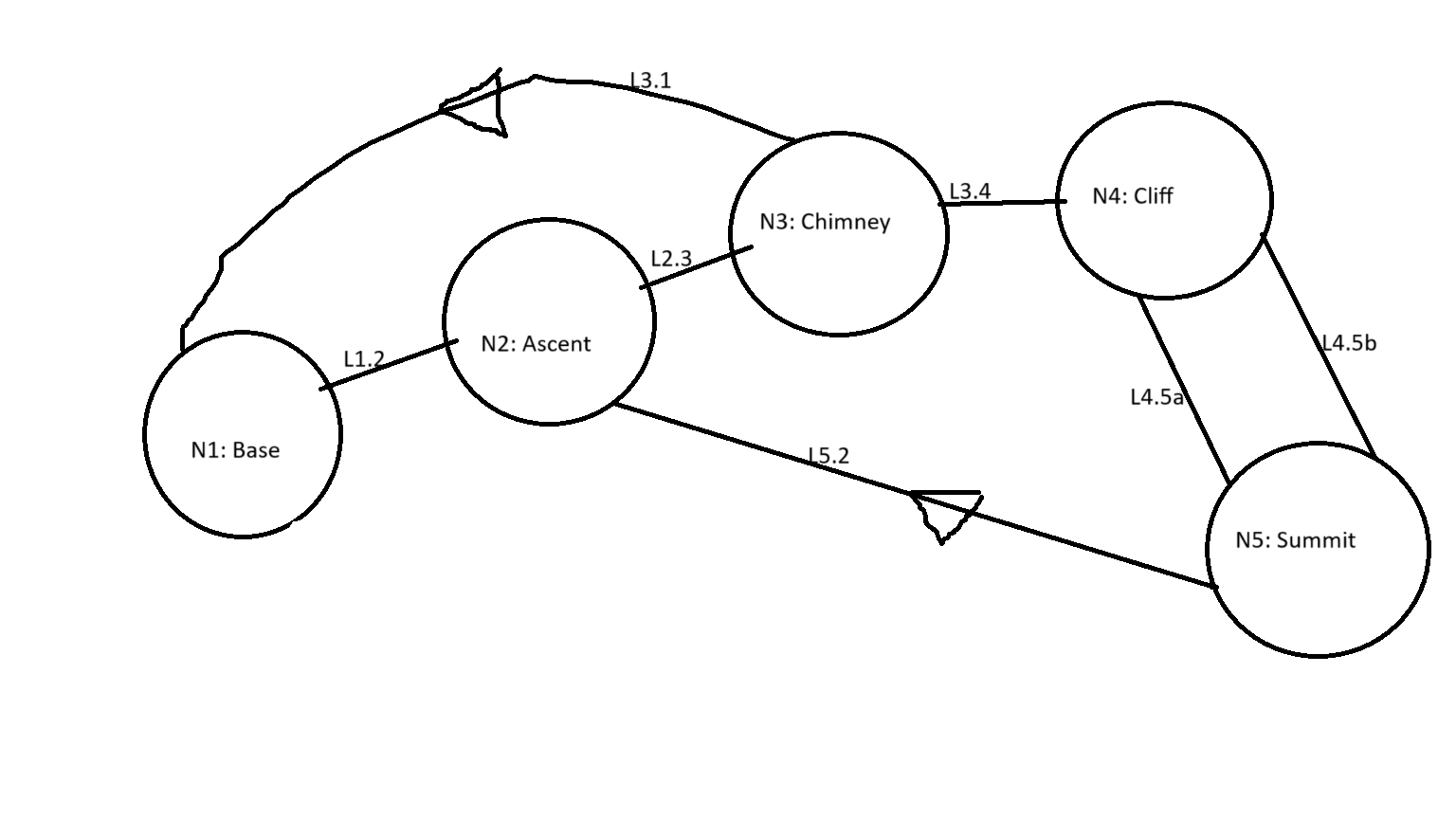
Here is a very simple example nodecrawl about climbing a mountain.  On the map, nodes are labeled as N# and linkages as L#.#.  The two numbers for a linkage are the two nodes they connect.  (It's easier to understand when looking at the map than the list.)  Details of linkages are defined only if they're interesting; otherwise, they are mentioned but not defined, and assumed to follow standard travel rules for the area and system.  One-way linkages are notated with a crudely drawn triangle on the map; they are also only mentioned on the node that you can take them from.


(Map note:  Note that the actual arrangement of the nodes doesn't matter, just the linkages between them.  I'm sure there's a better way to draw this.  I made it in Paint in 5 minutes and I can't draw the broad side of a barn.)

N1: Base of the Mountain

Linkages: L1.2

The base of the mountain.  Contains base camp as a point of interest.

N2: Ascent

Linkages: L2.3, L1.2

The ascent is crowded with other climbers.  This may involve social encounters, combat encounters, or environmental challenges including rescuing climbers who have fallen from higher up.

N3: Chimney

Linkages: L3.4, L2.3, L3.1

A narrow vertical climbing section, requires challenging skill checks to progress.  At the top of the chimney is a flat ledge that can be used to rest.

Linkage L3.1:  If characters fail badly enough climbing the chimney, they fall off the side of the mountain and are returned to base camp with a large amount of falling damage.

N4: Cliff

Linkages: L4.5a, L4.5b, L3.4

Linkage L4.5b: While the other path up is a standard vertical climb, a side path around the edge of the cliff offers an easier climb.  If located, this path offers a new linkage with easier climbing checks.

N5: Summit

Linkages:  L4.5a, L4.5b, L5.2

Linkage L5.2: A steep, winding slide offers a fast way down for characters willing to daredevil their way off the mountain.  Some sort of vehicle, like a sled, would make this path vastly safer than trying to slide down on foot.

In this particular example, the thing to note is that not every linkage is two-way.  The straight path up and down the mountain is two-way, but the chimney and the summit both have one-way linkages that go down the mountain to another node.  The cliff also has a secret linkage, not immediately obvious to characters, that provides an easier way up if located.

As a practical matter, what does this do for you, other than letting you use more sci-fi type words when describing your pointcrawl?  First, there are a few differences from the standard pointcrawl.  Most notably, there's the explicit definition that a node requires using your game's travel mechanics to leave.  A pointcrawl doesn't separate as cleanly and can include both traditional points of interest and major areas.  You can run a pointcrawl off a hexmap where every hex is a point, and every PoI is also a point, but there's not a lot of point to it.  With a nodecrawl, you can take a hexmap and make every hex into a node, then every path from hex to adjacent hex becomes a linkage, which helps define your travel in the imagined space while also providing a clear place for points of interest to occur along the linkage.  (In this case, every hex face would be a linkage, and you might have other linkages as well for shortcuts, underground passages, teleportation circles, and so on.)  Is that a lot of nodes?  Yes it is.  If you prefer, you can define a group of hexes as a node.  Your nodes don't need to be equal size to each other.  As long as you can travel around inside a node without invoking travel mechanics, and use travel mechanics to move from one node to another, the exact details of what a node is don't need to be consistent.

Second, it defines the paths as places of their own.  A path isn't just something that you scroll over in the background; it's a place that takes you from point A to point B.  It can have points of interest along it, and you know where those PoIs are and how to get back to them.

Third, we should all admit that as a practical matter, no, there isn't that much difference between the different kinds of crawls.  We're all describing the same kind of thing and the main diference is just whether or not the mapping used also maps cleanly onto your brain.  Use whatever presentation you like, whether it's a traditional hexmap, a pointcrawl map, a nodecrawl, the index cards from Skycrawl, or whatever else works for you.  Mix and match methods, and mix and match GM advice for different kinds.  If there's one thing to take away from this that's valuable, that bit is what I'd say is the most important; if you're running a hexcrawl, and you see someone giving advice for a citycrawl, you can probably still use that advice if it sounds cool to you.  All crawls are one and all advice is convertible between them.

The key to making a nodecrawl setup worth the effort is to use interesting linkages.  If every linkage you define is just a door between rooms, or a six mile border of clear terrain with no interesting parts, what's the point?  You put in a bunch of extra effort and got nothing out of it.  If a linkage between hexes is the only passage through the high mountains, suddenly this is an interesting fact about the world that might become relevant in other ways.  You have it defined, you know how it works to traverse it, and you know that it's the only passage between these two hexes (or is it?  is there a secret linkage, an ancient dwarven dungeon under the mountains?)  A teleportation portal might be a linkage between hexes that only works on a full moon (but takes you to the Abyss if you use it in a blood moon).

Also a fun fact to note; this method of organizing things doesn't have to actually refer to physical places in the game world.  You can use the nodecrawl structure for scenes in an adventure, progression through a magical ritual, decrypting a code book, or anything else that involves travel or progression (literal or metaphorical) from one thing to another along defined paths.  A nodecrawl can describe progression through time as well as through space.  (Space and time are, after all, related.)  You progress from one node to another in a skill challenge as easily as you do in a dungeon crawl.  (This also fixes the biggest problem with skill challenge type designs, their failure to evolve to the situation; with a nodecrawl, you have clearly defined what causes the situation to change and what the new situation is once it does.)

Tuesday, February 18, 2025

Paths of Heroism (PF2E Proof of Concept)

 As part of my current exploration in PF2E, I'm collecting a set of houserules that I would use which I am currently calling PathfindOSR.  I like many of the things PF2E is doing, and it's useful to me to have the large amount of content that it has, but there are also a lot of ways that I would like it to be more like an OSR game.  This post is a proof of concept of one of those ways that have the placeholder name of Paths of Heroism.

So one common thing I see with people is that PF2E has too many choices with its feats for them and they would prefer to make fewer choices; not no choices, or just one choice, but fewer.  Paths of Heroism are a set of feat packages that cover a tier of levels so that players can make one choice covering multiple feats, reducing the number of choices for class feats from ten (ish) to three.  With names stolen from Shadow of the Demon Lord/Weird Wizard for now, I'm calling them Novice Paths of Heroism (levels 1-6), Expert Paths (levels 7-14), and Master Paths (levels 15-20).  (Really, it's levels 8-14 and 16-20, since class feats show up at even levels, but it feels better to me to list the whole set of levels.)  Each path is given a Role, which right now I'm just using the 4E roles (striker, controller, defender, leader).  If feats involved in a path require or work best with a certain skill or set of gear, that's included in the Path description as a recommended thing to have or use.

It's also possible to create Paths for skill feats or general feats to help optionally trim down character building choices even further, but that's beyond the scope of this current proof of concept.

As a proof of concept, here's a few Novice Paths for the fighter class.  Fighters get class feats at levels 1, 2, 4, and 6.  There is no guarantee that these paths are optimal or good, but they demonstrate the concept.

Fighter Novice Path - Tempest
Role: Striker
Recommended Gear: Two weapons, at least one of which can deal piercing damage
Feats: Double Slice (1st), Lunge (2nd), Twin Parry (4th), Revealing Stab (6th)

Fighter Novice Path - Wrestler
Role: Controller
Recommended Gear: A free hand
Recommend Skill: Athletics
Feats: Snagging Strike (1st), Combat Grab (2nd), Slam Down (4th), Dazing Blow (6th)

Fighter Novice Path - Blocker
Role: Defender
Recommended Gear: Shield
Feats: Sudden Charge (1st), Aggressive Block (2nd), Powerful Shove (4th), Shield Warden (6th)

And so we can see that with a little work, we can turn one gun into five guns.  Which actually went the other way around when Moe said it, just like these choices, where we turned four choices into one choice.

These are pretty easy to make, but of course they can't cover every possible combination of choices (ignoring that there are some feats that make no sense to be taken together, and also ignoring archetypes and other out-of-class options, and also assuming that you always take a feat at the maximum available level, there's 10,560 possible novice paths to put together here for fighter) and they shouldn't be expected to or intended to.  Paths can cover some common character goals with a set of feats that's good enough to fulfill that particular fantasy.  If a player wants to be more specific with their character build, they can pick feats themselves, or they can take most of the feats from a path but swap one or two of them out.

The intent of paths is to simplify choices, not to restrict players, and a player can always just go back to picking feats themselves if they want to.  But if they don't want to think too much about it and just make one choice that works well enough, they can pick a path and be done with it.

Tuesday, January 14, 2025

Random Historical Events

 ...or at least their names.

I had an idea for a useful table that would actually fit in a blog post and said to myself all right, let's do it.  This is a system/table for generating the name of a random historical or important event.  It may be something that you use as part of hyperdiegetic information, or something that you use as part of more traditional worldbuilding, or maybe just something you needed a character to say and will never think about again.

To generate a historic name, first roll 1d12 to find the shape of the name, then roll 1d20 on each column that it directs you to.  Feel free to add or remove any pluralization as needed to make it sound cooler to you.  The intermittent words may also be edited as needed, though ideally in most cases they won't need to be (easiest is to swap articles, such as a/the).

Roll (1d12)	Event Name 1	The [Time] of the [Adjective] [Noun] 2	The [Noun] 3	The [Time] Without [Noun] 4	The [Time] of [Noun] 5	The [Adjective] [Time] [Noun] 6	The [Noun] of the [Adjective] [Time] 7	The [Noun] of [Noun] 8	The [Noun] [Time] 9	The [Noun] [Noun] 10	The [Adjective] [Noun] 11	The [Adjective] [Time] 12	The [Adjective] [Time] through [Noun]


Roll (1d20)	Time	Adjective	Noun 1	Day	Cloudy	War 2	Night	Thousand	Revolution 3	Hour	Deadly	Scream 4	Week	Flaming	Monster 5	Month	Hundred	Dragon 6	Year	Fanatical	Wrath 7	Century	Mysterious	Tempest 8	Time	Ubiquitous	Sunrise 9	Term	Jagged	Nightfall 10	Period	Venemous	Eruption 11	Moment	Questionable	Catastrophe 12	Season	Incandescent	Severing 13	Before	Global	Surge 14	After	Endless	Disaster 15	Summer	Lean	Incident 16	Span	Secret	Prophecy 17	Flowering	Ethereal	Irregularity 18	Harvest	Needless	Death 19	Eternity	Chromatic	Resurrection 20	Roll twice*	Roll twice*	Roll twice* 	*(when rolling twice, replace a different word in the name with your second roll)


Some example historical events created with these tables:

The Secret Year
The Irregularity Century
The Season of Resurrection
The Eruption
The Flaming Eternity Disaster (maybe adjust that to Flaming Eternal Disaster in this case).


Wednesday, December 18, 2024

Design Threads, Compiled

This post is a compilation of some threads that I wrote on twitter about game design a few years ago.  I'd probably write them a little bit differently if I was writing them today, or not for twitter, but instead of rewriting them I'm just copying and pasting.  This is currently a draft as I type this, maybe by the time it's a post I'll actually edit them.  On the other hand, if you're reading this, that means I didn't.

Basic Mechanic Design Steps

So here's a ramble about my process when designing a new mechanic.

The first step is to ask some questions: Why do I want this mechanic? What is the use case where players will interact with it? What is the intended gameplay experience? Do I need this mechanic, or are these use cases and gameplay experiences already adequately covered by existing mechanics?

Assuming I decide that the mechanic is needed, then I continue. At this point I have the expected use case and desired gameplay experience. These are the two most important things about the mechanic and the things that I keep in mind throughout the entire rest of the process. Let's take an example I designed; rules for running away from combat in Against the Fall of Night. Sometimes a combat just goes bad and you want to run away.

My expected use case is: Players are in a combat that they don't want to be in, so they decide to run. My desired gameplay experience is: Running has a cost, you can't just run at the drop of a hat, but you're reasonably likely to make it if you flee and the cost doesn't feel punishing even if you fail.

Is this a needed mechanic? Standard D&D-like combat movement systems make fleeing basically impossible. You can disengage, but they'll just follow you, and unless you move faster than them (which you usually don't, especially not in armor) then you're not making any real progress. AFN has similar combat movement mechanics, so yes, this is a desired experience that is not served by existing mechanics; it's worth adding.

The mechanic that I designed, put in what is basically system-neutral psedudocode, is: Everyone fleeing gives up their turns for a round. At the end of the round, everyone fleeing makes a check and everyone chasing makes a check. If half of the fleers succed, and half of the chasers don't, they get away. If half the chasers succeed, and half the fleers don't, escape is impossible. Any other result, it becomes a running battle where you automatically check again at the end of each round.

I check it against my ideals. Use case: Yes, you can run away in combat using this rule (you better be able to, that's all it does). Yes, it costs you something (all your actions for one round); but it's not a one-and-done roll. It always only costs you your actions for one round, not your actions for the rest of the combat, even if you fail. And if you end up in a running battle, it adds tension and changes the nature of your choices; with you knowing that the fight might end at the end of each round, you'll make different choices than you might otherwise.

And it also adds possible tension in the form of heroic sacrifices, by specifying 'the enemies chasing' instead of 'all enemies'; if you can make it so that some enemies can't chase, maybe by blocking the corridor, then those enemies don't get to be part of the check.

This is obviously an alpha rule, since I wrote it the same day as this original thread, and it's subject to plenty of change and revision. Almost nothing ever stays in its original form (iterate, iterate, iterate!) But, at least on a twitter-appropriate level of verbiage, that's my basic mechanical design process. Focus on the use case and the gameplay experience, make the math and design match it, and then iterate it until your eyes bleed.

Dice Mechanics

Last time I mentioned making the math and design match the use case and gameplay experience, but didn't actually say anything about how to do that. This time I'm going to talk about dice and how I pick which dice to use for a mechanic.

It doesn't cover every possible trick you can do with dice, but most of the time, you can separate dice mechanics into two kinds; one die or multiple dice. One die is a mechanic like D&D's d20 rolls; you roll a single die, you add whatever, you compare it to target, you're done. Multiple dice can be done by adding the pool vs a target, or by checking each individual die against a target. The big difference between the two is probability.

On one die, all results are equally likely. On multiple dice, the results are on a bell curve. One die has a lot more swinginess as a result. If you're rolling a d20, a 1, a 10, and a 20 are all equally likely. If you're rolling 3d6, a result in the 9-12 range is almost 50 times as likely as getting a 3 or 18! (100 times as likely as 3 or as 18, each). So if you have, say, a +1 modifier and you need a 10; this is a 60% chance on a d20, but a 74% chance on 3d6. As your modifier grows, the difference gets bigger. With +5, it's a 80% chance on a d20 but a 98% chance on 3d6! You're ten times as likely to fail on the d20.

What does this mean for game design? It means that a single-die system emphasizes randomness and elements outside your character's control, because failure is always a meaningful chance due to the machinations of the die. If your goal is to create a mechanic where the player is never sure what's going to happen, and where failure is always an option, a single-die is a good choice.

If your goal is to create a system where predictable tasks can be performed predictably, then a single-die is probably going to be too swingy for you (which has led to some of the complaints about D&D's skill system, historically). To emphasize skill and experience over chance, a multi-die system will give you results that are capable of staying random at low modifiers but scale towards determinism at higher modifiers.

Does it matter what kind of multi-die system you use? Yes, but not for this discussion. Successes and sum vs target both follow a bell curve and both fundamentally share the same elements in this regard, but they have different secondary tricks that you can do with them. It's also worth noting that the more dice you're throwing down, the more tightly bound to the bell curve the result will be.

Adding more dice to the pool isn't just a modifier on success; it changes the shape of the curve, which limits the effect of outlying results all on its own. It's a form of bounded accuracy enforced by probability, with the small chance of going way outside the expected results. If you roll 10d6, 68% of the time, it'll be between about 30 and 40. 95% of the time, it'll be between about 25 and 45. 99.7% of the time, it'll be between about 20 and 50. But 0.3% of the time, it'll be lower than 20 or higher than 50.

The mathematics of the dice bound the possible results pretty tightly, but allow for exceptional results in very rare cases. (For reference, the odds of having advantage and rolling a pair of 1's anyway is 0.25%; about the same as the odds of going below 20/over 50 here.) If you roll a d20, on the other hand...68% of the time it'll be between 5 and 15. 100% of the time it'll be between 1 and 20. That's it, that's all the confidence you get.

So what's the summary? Dice and math matter when designing a mechanic, because the players are going to interface with them, and the mechanics of the probability will determine the experience that the players have with the mechanic. If the players expect the mechanic to be predictable, but instead it's swingy, then your mechanic doesn't match the expected use case. Conversely, if the players expect it to be swingy and random, but it's actually very predictable, same problem. Make the mechanic as players experience it match what you want the gameplay experience to be; and picking dice is one way to control that.

Implied Incentives in Design

Today's discussion is about player choices and incentives as they relate to the mechanics that you design. Incentives and the results of choice are an important part of the experience that players will have as they interface with a mechanic.

Imagine you're designing a skill system. You have a variety of possible ways to do this. As always, we start with the goals; use case and intended experience. We'll assume that your game doesn't have a skill system yet and that you do need this mechanic. The use case is that a player wants to do a thing that isn't directly combat-related. The intended experience is that the more resources the player invests into doing this thing, the better they are at it.

There's already a lot going on here, and it ties into the tone and genre expectations of your game. But that's not the topic here so I'll just assert something. I assert, for this example, that characters should be able to range from untrained to highly skilled, and that their chance of success at a given task should increase each time they invest character resources into this skill.

Already we're making incentive choices. The incentive we're giving is that players can improve at their skill by spending resources. But the question becomes, then, how much do they improve? Is it better for them to specialize or spread it out? Will any choice offered to them ever feel like it was a trap?

(Don't do that, btw. Trap options aren't real choices.)

You can adjust these knobs with mechanics changes, and there's a lot of ways to get any given result, and this is (originally posted on) twitter. So instead I'm going to talk about why you might aim for one goal or another, and what that does to the player incentives.

Let's say that you decide that you start with 50% success, and you have four ranks, and each rank gives you +10% success. You can focus them in one skill or spread them across others. This is a fairly balanced option that makes both specializing and focus decent options. What if your success rates by rank 0-4 are, instead, 10%/50%/80%/90%/100%?

You can see a strong incentive here to have at least one rank in anything that you want to get done, and a second rank if you want to get it done reliably. Because of the huge jump between ranks 0 and 1, it's unlikely that anyone would put all four ranks in one skill, so they're rewarded with 100% success rate if they do. There's incentives for both.

But what if it was 10%/50%/80%/90%/91%? I don't think you'd see a lot of rank 4's in there. That extra 1% is not a strong incentive and would not feel rewarding, especially not when they could be putting that to make something else from rank 0 to 1 and getting a 40% boost. By considering the incentives that your mechanics offer to players, you can analyze the experience that they'll receive when making these decisions, which in turn will affect their satisfaction with the mechanical interface of your game.

I've only been talking about character building here, but the same principle can be applied to actions in-game. Some games have a stunting mechanic, where if you take a recklessly awesome action, you get a bonus to your resolution. This is an incentive. Recklessly awesome actions are often unlikely to succeed and very dangerous to the player; so they're fairly uncommon. If you want to make them more common for genre or gameplay experience reasons, you can provide players with an incentive to take these actions, and that's what stunting does. (Of course, this can also generate undesired results, like players competing to take the most over-the-top action, but that's a separate topic.)

Another example of an incentive in gameplay is the oldschool XP for GP rule. You gain one XP per GP value of treasure that you safely return to town with. XP for GP reduces the value of combat, because combat is dangerous and grabbing unguarded loot isn't. It leans players towards wanting to play carefully, because they need to return safely, and to find ways to get loot without combat. If that's something you want for genre or gameplay reasons, that's something that XP for GP can do.

Incentives can be a very strong design tool for gently leaning players towards the expected experience. Don't go too heavy with them, though, because an incentive that's too heavy isn't an incentive anymore; it's a balance problem. But whether or not you use them intentionally, they'll always exist in your design. Thinking about your mechanics in terms of incentives is a useful way to help predict what kind of gameplay experience a player will have, and to figure out whether or not that matches your intent.

Mechanical Variance

Today, I'm talking about the value of variability in mechanics, and why you might want a mechanic to be highly variable; or, perhaps more accurately, why you want to avoid an entire character being low-variance.

High-variance and low-variance characters have existed in a variety of ways in different RPGs. I'm going to draw my examples in this thread mostly from D&D 5E, because lots of people are familiar with it and it can handle it if I say anything that could be considered negative. One of the most traditional examples of variance differences is the fighter versus the wizard.

A fighter, in the majority of combat situations, will find themselves taking the Attack action. Because of the way 5E balances attack bonuses vs AC, using HP as a primary defensive stat, you can have a pretty good amount of confidence in what the attack will do. It will very likely do damage within the expected bounds.

A wizard, in most combat sitautions, will cast a spell. What will the spell do? That depends on the spell, the targets, any required saving throws, the terrain, and so on. It's almost impossible to predict the actual result on the battlefield just by knowing that a spell will be cast; whereas the fighter's attack is very predictable.

So we can see that the wizard has much higher variance in combat than the fighter. There are other ways to increase variance too. A fighter using Sharpshooter or Great Weapon Mastery will have a higher variance than one who isn't; with the attack penalty and damage boost, they can get huge swingy differences outside of their average result. So we know that there's ways to get lots of variance in combat. What does this tell us about the value of it, though?

If we look at the most common complaints about the fighter, it tells us that variance is fun. Variance feels like power. The most common complaints about the fighter are that it's boring or underpowered. The fighter isn't underpowered. It's a very strong class. But it doesn't always get those same kind of high-variance spikes that we can see from other classes, which can make it feel less powerful.

Imagine a class that had one attack, always hit, and always dealt 5 damage (at first level). This would be a very strong class! But would it feel strong, next to a character who might occasionally spike something much more effective than it?

Introducing high and low points into a class experience, rather than keeping them as a smooth average, allows for players to feel good about the awesome thing they just did. Assuming the amount of low points are kept in check (missing all the time isn't fun, but the attack roll itself wouldn't be fun if you could never miss), and the high points need to be kept appropriately rare as well - it's not as awesome if it's just something that you can do all the time, variance introduces a feeling of power and fun that can be lacking when things are too predictable.

This is all, of course, in addition to the fact that variance introduces tension and excitement to dice rolls (if there's no risk of a meaningful failure, why are you rolling?), but that's generally better-understood intuitively and I rambled on long enough for today. Agency is also a different topic; variance can be controlled or uncontrolled, and that's about agency, not the variance itself.

System is Setting

This time, an opinion that not everyone might agree with. But I think it makes better games. System is setting.

What does 'system is setting' mean? All mechanics contribute to the experience of gameplay. A setting is implied by the system, and if the implied setting does not match the narrative setting, you end up with a disjointed experience. You can't play LoTR in 5E any more than you could play WoW in 1E. (Side note: You can play LoTR in 5E with Adventures in Middle-Earth, if you have a copy. But AiME makes significant systemic changes to make this possible. Which goes to my point; system is setting, and in order to make the setting work with LoTR, it was necessary to adapt the system.)

While I'm talking about this, this is something that @\cavegirl knows very well and talked about while designing Dungeon Bitches. It's on DTRPG now and you can go check it out. She designed mechanics of the game not just to create the desired gameplay experience, but to reinforce the themes and tell a story about the world at the same time.

So back to system is setting. All systems create an implied setting with what they put in the book, even if they don't have a specific setting. Some of this is place names and monsters and so on, some of it is mechanics. This was commonly seen in 3E, where people would use the demographics and magic shop tables from the DMG to create the setting of their world.

Another common example is when people try to play Star Wars in whatever system they like, often 5E currently, and it doesn't work at first. You can't just add mechanics and make the system Star Wars; you need to remove mechanics too. For Jedi to make sense and tell the same stories that they tell in SW, you can't just have space monks with laser swords. You need traditional spellcasting to not exist, you need armor and weapons to work differently, and you need the Dark Side to be a thing.

This is in part why generic systems almost always lead to kitchen-sink fantasy worlds. Again, something that we saw a lot of in 3E. As book after book was released and more and more options crowded their way into the world, whatever setting you started with became less distinct over time as it just continued to be the same kitchen sink as every other setting that had all these same elements in it.

5E was originally designed as a modular generic core where you'd add only what you needed for a given campaign, and you can still see an echo of this in the DMG in the section where it just has ~100 pages of optional rules. That would be a very flexible system, where you could just have your core resolution mechanics as reliable and then add in what you needed bit by bit.

But even then, something as generic as a core resolution mechanic of roll d20 + mods vs DC still implies things about the setting. It doesn't work for professionals doing professional tasks; a character with +5 vs a DC 10 (Routine) task has a 25% chance of failure! But a roofer, even a 1st level one, does not have a 25% failure rate per roof or per shingle. The d20 is designed to create that failure chance to generate interesting gameplay in the aspects that D&D focuses on, high-tension moments, and is not well-suited for reliable tasks in low-tension moments.

So we can see that even a mechanic as simple and generic as the d20 + mods vs TN still contributes to the implied setting and expectations of what the characters will be doing. Any mechanic that is generic enough to work for every possible setting is too generic to be interesting. Similarly, we can see the same kind of thing in a healing system; imagine a system where all characters are healed to full after every encounter, all resources recovered, everything is perfect. It would be impossible in this system to tell the story of a group of rag-tag adventurers getting beaten down over time but refusing to give in, because they're always at full resources!

The system influences and guides the kind of stories that the gameplay can tell. This is part of why I feel it is so important, when creating a system and making mechanical design choices, that you consider these questions. What kind of setting is implied by this mechanic? What kind of stories does this mechanic enable? What kind of stories does this mechanic make more difficult or impossible?

System is setting, and it's important and valuable to ensure that your system supports and enables the kind of stories that are core to your setting.


Monday, September 2, 2024

In Defense of Subsystems

 Many RPGs these days use a universal resolution system that covers all parts of the game.  This was popularized with D&D 3rd edition and the "d20 System", the idea that no matter what you're doing in-game, you roll a d20, add modifiers, compare to a target number, and you succeed if you beat the number.  I'm going to explain why this is bad (or, at least, shouldn't be used for every situation in every game).

This is distinguished from older games where you would have different rules to resolve the situation depending on what you were doing.  Using AD&D 2E as an example (because it had a ton of these), you might make a Strength check by rolling 1d20 to roll under your Strength score.  But if you were trying to perform a major feat of strength, you would instead of a percentage chance to Bend Bars/Lift Gates (the exact percent is determined by your Strength score).  Or if you were trying to kick open a door, you'd roll your Open Doors score instead, with a different distinct target number if the door was magically sealed.  Obviously, there's a lot going on here, and maybe we don't need three or four different subsystems just for doing strong things.  But that doesn't mean that we shouldn't have subsystems at all.

The point of subsystems is to allow your gameplay to feel different when your character is doing different things or going through different experiences.  It creates tactile feedback for the player that mirrors the kind of feedback the character would have.  The value added is that feedback, the experience actually being different and not being the same gameplay with a new coat of paint.

Does it add friction?  Yes, of course it does.  Every mechanic adds friction in resolution.  Sometimes that's the point of a mechanic - go read jay dragon's post about how rules are a cage.  I don't necessarily agree that that's the point of every rule, but absolutely it is the point of some rules.  Sometimes the point of a rule is to restrict the player, to add friction, to make it so that your whim as a player is not the only thing that affects the character and the shared imagined world.

The resolution of every rule creates an experience and, when done right, will reflect the experience of the character.  This feedback helps ground the player in the game and should make it both more interesting and more real.  If your experience as a player is identical whether you're in combat or fixing a wagon wheel, then the game is not accurately providing that feedback to you about the experience your character is having.  If resolving the rules to fix a wagon wheel is a meditative experience, while combat is tense and frenetic, then we've got something much more interesting here than a smoothed-out universal resolution system that relies on the player to provide anything of value.

So to go back to our feats of strength, maybe you just use a normal roll for normal things.  If you want to do something that would break a record, you'll need to do something more difficult.  The friction involved in resolving the more difficult task - the pushback that the rules give you, when you try to resolve the action - that mirrors the pushback that the world gives the character when the character tries to take the action.  In this way the rules serve to reinforce the roleplaying loop, by giving the player an experience that's analogous to the experience the character feels.

And certainly we don't want it to be exactly the same thing the character feels in a lot of situations (no one needs to get stabbed just because your character did), but if you feel something mildly unpleasant because your character is in an extremely unpleasant situation, that's working as intended.  If resolving the rules to determine whether or not your party member dies after their severe injuries causes you to feel stress and tension, that's a good thing.  

And if a negotiation with the king feels exactly like a relaxing day fishing which feels exactly like combat?  Something is being lost, there, and subsystems are how we get it back.

Monday, May 20, 2024

Solo Boss Encounters in D&D-Like TTRPGs

 Solo boss encounters are a common thing that people want to do in D&D-likes, but the way the system is set up, they don't really work unless you mess with it.

This post is a description of how I mess with it to make them work better.  It might not work at all for you or maybe it will be the most brilliant thing you've ever heard of.  These ideas aren't new but also it's the result of mashing together decades of blogs and different RPGs and trying things out so I don't remember what the sources are.

So:  Solo boss encounters.  We're defining this to mean a challenging, interesting battle against a single combatant.  There's lots of other ways to make a 'boss' encounter but I'm not talking about those here.  The most common thing people try to make this work is to just use a higher level monster; this has various issues depending on system, but most often, makes for a frustrating experience because its AC is too high, its saves are too good, its damage is too high, or more than one of these things.  Then the action economy doesn't let it actually do enough things to feel like an active fight, because these games aren't designed for a 1vX fight, they're designed for lots of things to be on the field on both sides, so it just stands there getting missed/making saves and then one-shotting people.  Tonberry is a boss fight, all right, but it's not really the one that people are looking for most of the time.

The trick I use is basically, just duct tape a bunch of monsters together and make it a single monster, then invert the action economy.

Duct taping them together is relatively understandable; just mash them all up as if the party was facing multiple monsters.  Inverting the action economy only takes a tiny bit more explanation.  If the party was actually facing multiple monsters (let's say five ogres), then the enemy team would start out with five actions per round and go down to one action per round as the party dealt damage.  This leads to a cleanup phase and an anti-climactic finish.  Inverting the action economy means that the solo monster starts with one action per round, and as it takes damage, this increases until it's up to five actions per round.

For crowd control effects, obviously those have impacts on the action economy, and the answer like most answer is based on thinking 'what if it was five separate monsters'.  For each unique CC effect that would prevent them from taking actions, they lose one turn.  If they're paralyzed, they lose one of their turns each round; a second paralysis effect does nothing.  If they're paralyzed and stunned, they lose two turns each round, but another paralysis or stun wouldn't make it any worse.  This makes AoE CC less valuable against the duct taped version than it would be against the individual monsters, but because this lines up with the desired villain fantasy, that's all right, and it allows for CC to be useful against the boss encounter without ruining it.

You could probably figure out how I'd do this from what's written here already, but let's make an example monster instead.  I'll use the Ogre (CR2) from D&D 5E as an example here because basically everyone knows how to read 5E statblocks and Ogre is an SRD monster.  I'll start by going through each stat and describing what the effect of duct taping a bunch of them together (five, specifically, in this case) has on that stat.

Armor Class:  Unchanged.  Five ogres each have the same AC as one ogre.
Hit Points:  Multiply by five; five ogres have five times as many hit points as one ogre.
Speed: Unchanged.  Five ogres can move more often than one ogre, but not further, so speed changes are covered by action economy changes instead of altering the speed.
Ability Scores: Unchanged.
Senses, Languages, CR: Unchanged.  However, for CR, of course when encounter building you should consider this to be a number of creatures equal to the number you duct taped together; five ogres is five CR 2 creatures.  This means that the XP value listed in the statblock should be multiplied.
Actions:  Unchanged.  Just like speed, five ogres can attack more often than one ogre, but they don't do any more damage.

And then the only change needed outside the statblock is initiative/action economy.  Check the number of hit points a single creature of this type has.  Each time the monster loses that many hit points, it gets to take another turn in the round.  One ogre has 59 hit points, so each time five ogres duct taped together loses 59 of its hit points, it gets to take another turn each round.  (The five combined have 295 hit points, which sounds like a lot but is exactly as many hit points as you'd have to chew through to kill five ogres.)  You can roll initiative for it multiple times if you want, but usually it's easier to assign fixed numbers that each turn occurs on; you can either count down or count up.  Ogres are slow, so we'll have this one count up; they take their first turn on initiative 5, second on 10, third on 15, fourth on 20, and fifth on 25.  It'll start out slow as the party expects, and then become blindingly fast and dangerous at the end.

Depending on the party and the monster, you might find that damage values are scaling fast enough that your monster isn't getting to access all of its turns because it's being blasted through HP lines.  If this is happening, optionally, you can give them a bonus immediate turn right when the line gets passed.  This is also a great time to do any sort of phase transition you might want to do; maybe the ogre lights its club on fire and the damage becomes fire when it gets up to taking three turns per round.

And that's all there is to it.  Here's the statblock.

Five Ogres Duct Taped Together
Large giant, chaotic evil
Armor Class 11 (hide armor)
Hit Points 295 (35d10 + 105)
Speed 40 ft

Initiative:  Five Ogres Duct Taped Together don't roll initiative; instead, they act at initiative 5.  Each time FODTT loses 59 hit points, they can take one more turn each round, at an initiative count 5 higher than their highest current value (5, 10, 15, etc, up to 25 when they are down to 59 hit points or less).  (If you rolled hit points for FODTT, this occurs each time they lose 1/5 of their maximum hit points.)

Str 19 (+4), Dex 8 (-1), Con 16 (+3), Int 5 (-3), Wis 7 (-2), Cha 7 (-2)

Senses Darkvision 60 ft, passive Perception 8
Challenge 2 (2,250 XP)

Actions
Greatclub.  Melee Weapon Attack:  +6 to hit, reach 5 ft, one target.  Hit:  2d8+4 bludgeoning damage.

  • Javelin (Melee). Melee Weapon Attack: +6 to hit, reach 5 ft., one target. Hit: (2d6 + 4) piercing damage.
  • Javelin (Ranged). Ranged Weapon Attack: +6 to hit, reach 30/120 ft., one target. Hit: (2d6 + 4) piercing damage.

Tuesday, May 7, 2024

Rules Fragment: Nightfall Tactics

 Today I had a thought and had to write it down, so here we are.  This is the design fragment of a tactical wargame using the basic core of the Nightfall Engine (from Against the Fall of Night).  Rules terms that are referenced, but not defined here, are the same as in Against the Fall of Night.

Nightfall Tactics

A wargame/SRPG/tactical game built off an extension of the Nightfall Engine.

Tactics Skill:  Your default Tactics Skill is equal to half your Combat Skill.  Tactics Skill is used as the basic resolution roll for this layer (for example, if you're determining the effect of your infantry attacking, you roll Tactics Skill instead of an attack roll).

Strategic Skill:  Your default Strategic Skill is equal to half your Mind.  Strategic Skill is used to determine starting setup, layout, limits of units you can command, and so on.  It would be tested to determine if you can successfully ambush someone, get to the high ground before combat starts, etc.

Units can be actively commanded, or just on your team.  The number of units you can actively command is determined by your Strategic Skill, but you can have as many units on your team as you can hire (see the note on Wealth and Economy later).  You can only use your Tactics Skill to benefit units that you’re actively commanding.  (Thus a character with very high Tactics Skill, but low Strategic Skill is a fantastic sergeant or lieutenant who commands a single unit; a character with high Strategic Skill but low Tactics Skill is still useful as a commander of a large number of units to prevent them from default-stats.)

Feats can increase or affect both Tactics Skill and Strategic Skill.  (For example, a feat Magical Tactics:  You can use your Magic Skill instead of Combat Skill to calculate your default Tactics Skill.)

Strategic Spells:  Big battlefield versions of magic.  They take 10 minutes to cast (which is 1 round at this combat scale) and require the support of a company of mages (60 people who each have Magic Skill +1 or higher).  (Optionally, a total Magic Skill of 60+ is required, so you could have ten 6th-level thaumaturges cast one, if you somehow have those available.)  Caster characters can learn strategic versions of spells that they know with a feat.

Strategic Techniques:  Combat techniques scaled up to battlefield scale.  Martial characters can learn strategic versions of combat techniques that they know with a feat, and then units they command can use those techniques.

Units would be designed like monsters, with levels, stats, and basic attack and defense techniques.  The commander stats can replace certain stats here (like the unit would have a Combat Skill of its own, but a commander can use their Tactics Skill in place of it).

Units have Cohesion and Health in place of Vitality/Wound.  Cohesion reflects their ability to keep it together, Health is how many of them are still alive.  Like AFN, melee attacks that are not defended against deal damage directly to Health, while those that are defended against attack Cohesion first.  Ranged attacks always deal damage to Cohesion first, unless their attack test is a modified 21+ and the attack was not defended against.  Undead, constructs, and other mindless/controlled troops have Cohesion -, because they never break Cohesion and need to be actually destroyed.  Cohesion is also the Morale rules; when a unit hits 0 Cohesion, they need to make a check of some kind to stay on the field or else they disperse.  Whatever the check is by default, it can be replaced with a Tactics Test if the unit is being actively commanded.

Initiative phases are Ranged, Cavalry, Infantry, Magic.  (Flying cavalry, as a special ability, get to act in the Ranged phase.)

Strategic spells can’t be cast if the unit has been attacked that round, though the mage unit can still use their normal techniques.  Only a character with Magic Skill +1 or higher can actively command a magic unit; they just use their default stats if you don’t have at least Magic Skill +1.

Economy:  For balancing units against each other, there is some form of economy.  Units cost Wealth.  You can only keep a number of units supplied with total Wealth cost equal to your Wealth.  Default Wealth cost is Level, double for cavalry, but specific units may be more or less expensive.  (Note that multiple people can combine their Wealth to supply an army.)  (Note:  This makes it difficult for normal players to bankroll an army, and right now I don’t care, integration can get figured out later.)

Units don’t use Attack Points, Defense Points, or Magic Points, because a round is 10 minutes long and they have a ton of all of those points.  Instead, every technique or spell they have is very situational with distinct strengths and weaknesses.  If the unit has something that’s always useful?  That’s their special ability, being generically useful.  Each technique can only be used a specific number of times per round, usually once unless specified otherwise.

Units normally can’t do things that would make them Vulnerable while in melee.  Unlike individual characters who get to choose that kind of thing, units just aren’t given the choice.  A successful Tactics Test can get them done, or units with – Cohesion can do so automatically.

Damage is generally the same thing as on personal scale.  Rough default is 1d6 + Combat Skill, reduced by Armor which is usually approximately equal to Level.  Aura for undead, constructs, and anti-magic units.  Cohesion/Health is roughly half what Vitality/Wound would be on personal scale; units die faster than heroes (but it’s rounded to even numbers to make things easier to track).  Like personal scale, units can be ogre-sized or giant-sized as well, which makes them terrifying.

Units have facing.  We’re making a square-based wargame because I’m a heretic.  A unit has three front squares, two flank squares, and three rear squares.  Attacks from a flank have slight advantage, attacks from the rear have high advantage.

Weapon triangles:  We’re adding weapon triangles based on weapon qualities.  Cunning, Brutal, Reach.  Brutal > Reach > Cunning > Brutal.  If you’re on the good side of the triangle, you have slight advantage.  If you’re on the bad side of the triangle, you have slight disadvantage.

Basic unit statblock:
Wealth Cost, Level
Combat Skill, Magic Skill
Armor, Aura
Cohesion, Health
Attack Techniques/Defense Techniques/Spells

Two example units.

Militia (Infantry)
Wealth Cost 1, Level 0
Combat Skill +0, Magic Skill +0
Armor 0, Aura 0
Cohesion 2, Health 2
Attack Techniques
Swarm – The militia make a melee attack.  1d20+0, 1d4 damage.  On a miss, the militia take 2 damage.

Spearfighters (Infantry, Reach)
Wealth Cost 1, Level 1
Combat Skill +1, Magic Skill +0
Armor 1, Aura 0
Cohesion 4, Health 4
Attack Techniques
Long Strike – The spearfighters attack a target one square away from one of their front squares.  1d20+1 to hit, 1d6+1 damage.  This technique cannot attack adjacent targets.
Defense Techniques
Brace – The spearfighters set their spears to defend.  If the attacker misses, they lose 1 Cohesion.